Woven in Courage · Episode 02
The Netherlands on the eve of invasion.
A country preparing for war while hoping to escape it. Warnings that kept arriving. And a seventeen-year-old in Groningen whose future was about to change.
Listen to Episode 2
The Netherlands on the Eve of Invasion · 26 min
For months, the warnings had come. Germany would attack. A date would be passed along. The Netherlands would wait.
Then the date would pass.
The danger was real. So were the German plans. But repeated postponements made an approaching invasion harder to judge: how could officials distinguish the warning that mattered from another alert that would end in an uneasy morning of relief?
On May 10, 1940, there would be no postponement.
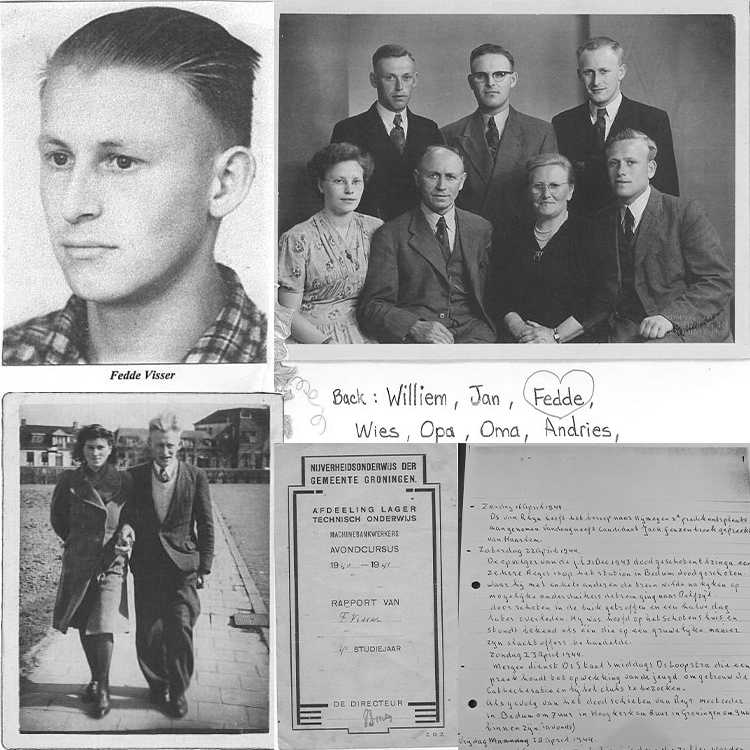
My grandfather was seventeen, living in Groningen. The man whose journal would one day reach me was still a young person with most of his life ahead of him. Within days, the country around him would be under German occupation. The future he would have to navigate was becoming one he could scarcely have prepared for.
In Episode 2 of Woven in Courage, I step back from the journal to examine that narrowing interval between peace and occupation. What made neutrality seem possible? Who recognised the danger? And what happened when the question stopped being whether war would come and became how to live with its consequences?
Why neutrality still seemed possible
It is easy to look backward from May 1940 and see the invasion as inevitable. Living toward it was different.
The Netherlands had stayed neutral during the First World War. That experience gave neutrality credibility. Keeping out of the fighting was a policy that had worked before, and Dutch leaders hoped it could work again. For families trying to protect their homes and livelihoods, the possibility of remaining outside another European war mattered enormously.
Yet the world around them was changing. Germany annexed Austria in 1938. The Munich Agreement handed the Sudetenland to Hitler that September. In November, the attacks of Kristallnacht made the violence directed at Jewish communities unmistakable. When Germany invaded Poland on September 1, 1939, Britain and France declared war two days later.
The Netherlands remained neutral. It also prepared. The Dutch army had mobilised on August 28, before the invasion of Poland. Reservists left civilian life; preparations for air raids became visible in cities. By April 1940, the government had proclaimed martial law. Hope and preparation existed together. Anne Frank House: mobilisation and the invasion.
For me, that tension makes these months compelling. A government could prepare for an attack and still work to prevent it. A family could see military preparations and still expect to get through the next week much as it had the last.
But neutrality depended on something the Dutch could not control: whether Germany would respect it.
A country already carrying a heavy burden
War approached a society that had already endured years of economic hardship.
The Depression had affected work, wages and the price farmers could obtain for their produce. An economy dependent on international trade was exposed when markets contracted. The Netherlands held to the gold standard until 1936; research on that policy links the period to persistent deflation, unemployment and declining national income. Fliers and Colvin, “Going Dutch.”
Those pressures belong in this story because people do not put ordinary responsibilities aside while history gathers around them. There was still work to find and food to pay for. Farmers had debts and uncertain prices. Urban workers faced insecurity. Families had reasons to value whatever stability they could preserve.
In Groningen, the setting of my grandfather’s life, the wider political crisis existed alongside those everyday concerns. Family, work and religious community helped give life its shape. The prospect of war threatened all of them, without removing the need to get through an ordinary day.
I want to keep that scale in view. A map can show the distance between a border and a city. It cannot show what that distance means to someone whose home is there.
For refugees, the danger had already arrived
The idea of a country still at peace needs a harder qualification. For Jewish refugees escaping Nazi Germany, persecution was already a lived reality.
The Netherlands offered refuge to some, but admission was restricted and uncertain. A November 1938 American diplomatic report recorded Dutch officials seeking an international arrangement for refugees and threatening to close admission if one could not be found. It also reported that some refugees had recently been admitted under more lenient border instructions. Humanitarian help and restrictive policy existed side by side. US diplomatic report, November 16, 1938.
That is a different history from a simple picture of a safe country waiting for war. People seeking protection were already confronting decisions about who would be allowed to enter, who would support them, and where they could live.
In 1939, the Dutch government established Westerbork as a camp for Jewish refugees. The first residents arrived that October. Its later history makes the date painful to read: in July 1942, the German authorities would take over the camp and turn it into a transit camp for deportations. These were distinct stages, under different circumstances, and they must not be collapsed into one. United States Holocaust Memorial Museum: Westerbork.
The invasion would bring a further rupture. Nazi anti-Jewish occupation measures would follow German control of the country. Before that, antisemitism and restrictions on refugees had already left people vulnerable. Auschwitz-Birkenau State Museum: exclusion and registration.
For a refugee who had escaped Germany, the approach of German troops meant the possible loss of safety all over again. The border that once separated danger from refuge was about to be crossed by an army.
Faith could deepen the disagreement
Episode 2 also considers the religious arguments surrounding fascism. Religious affiliation did not produce one uniform response, and neither Catholic nor Protestant communities can be reduced to a single position.
Some Christians were drawn to promises of order and opposition to communism. Others recognised National Socialism as a threat to their faith and to their neighbours. The disagreement concerned what religious loyalty required when a political movement demanded obedience and ranked human beings by race.
One voice worth returning to is J. J. Buskes. In a 1937 publication, he challenged National Socialism’s claims over Christian life and opposed antisemitism through the Christian obligation to love one’s neighbour. His words show that religious criticism of Nazi ideology existed before the occupation. Buskes, Het nationaalsocialisme als bedreiging van de kerk.
These arguments matter because institutions are made of people who will eventually have to act. A conviction expressed before the invasion could become much more costly afterward. Once the occupier could punish opposition, a public statement, a refusal or an offer of help would carry consequences that a peacetime debate could not fully anticipate.
The coming occupation would test the distance between what people believed and what they were prepared to do.
The warnings that kept changing
Among the most unsettling threads in this episode is the effort to warn the Netherlands from inside Germany itself.
Hans Oster, an officer in German military intelligence and an opponent of Hitler, passed information to the Dutch military attaché in Berlin, Gijsbertus “Bert” Sas. The warnings included planned invasion dates. They were dangerous disclosures, made across a relationship of trust.
The problem was that Hitler repeatedly postponed the western offensive. Information could be accurate when passed on and still fail to describe what happened on the predicted morning. A recent study of the Oster–Sas intelligence relationship traces how these changing dates complicated the reception of the warnings. “Tactical Indicators and Warnings from Strategic Human Intelligence.”
The distinction matters. It is too easy to tell this as a story in which someone knew everything and everyone else simply refused to listen. There were warnings, doubts, military preparations and decisions made with incomplete knowledge. The Dutch did mobilise. They did take precautions. Those actions would not be enough to prevent defeat.
Knowing the outcome gives us a certainty the people in those months did not have. It also makes the sequence more disturbing. Each postponement allowed another day of ordinary life while the threat remained.
Eventually, the date on the warning and the date of the attack would be the same.
May 10 and the fight for the crossings
The invasion began in the early hours of May 10, 1940. German forces attacked by land and air as part of Fall Gelb, the offensive against the Low Countries and France.
The bridges in the episode are central to understanding the attack. Waterways could obstruct an army; an intact crossing could carry it forward. At Moerdijk and Dordrecht, German airborne forces sought to secure routes through the Dutch defences and toward Rotterdam. Seizing a bridge could change the possibilities for everything moving behind it.
But the campaign was not an effortless procession of German victories. Around The Hague, the attempt to capture the Queen and government failed. Dutch troops fought back. At the Grebbeberg, resistance continued through three days of heavy fighting before the Grebbe Line fell on May 13. Anne Frank House: the German invasion and Tweedewereldoorlog.nl: the invasion.
Remembering that resistance changes how we understand the defeat. A short campaign can still contain prolonged terror for the people inside it. Five days can hold repeated attacks, exhaustion, separation and decisions made without a clear account of what is happening elsewhere.
I cannot put my grandfather beside a particular bridge or inside a particular battle without evidence from his own record. His place in this episode is Groningen: a young man whose country was being invaded. The military events explain how the world around him changed; they do not substitute for his testimony.
Rotterdam and the decision to surrender
On May 13, Queen Wilhelmina and most of the Cabinet left for England. The government would continue in exile, but their departure was a profound moment for those who remained.
The next day, German aircraft bombed Rotterdam. Much of the city centre was devastated. The Anne Frank House records around 850 deaths and close to 80,000 people made homeless. With Utrecht threatened as well, General Henri Winkelman faced the prospect of further destruction if the fighting continued. He signed the capitulation on May 15. Anne Frank House: Rotterdam and the surrender.
Fighting continued in Zeeland, which was outside that capitulation. The Dutch government’s war against Germany would also continue from exile. The struggle was changing its form. Netherlands Institute of Military History: Zeeland.
For civilians in the occupied country, the most immediate change was that another power now held authority over their lives. The fighting might have stopped nearby. That did not tell them what the next order would demand, which assurances could be trusted, or how long the occupation would last.
My grandfather was still seventeen. He now had to grow into adulthood under that authority.
What would obedience cost
The aftermath is where this episode’s questions become the next episode’s story.
On May 29, 1940, Arthur Seyss-Inquart assumed civilian authority as Reich Commissioner. His public assurances of restraint were part of an effort to obtain Dutch cooperation. They did not describe the increasingly coercive occupation that would follow. Anne Frank House: the Nazis assume power.
Persecution would develop through orders, exclusions and registrations. Institutions that had once organised everyday life could be used to enforce the occupier’s demands. For Jewish residents, the consequences would become catastrophic. Understanding that progression requires attention to individual measures and the people who implemented, accepted or opposed them.
Resistance, too, has to be followed as it developed. The networks familiar from later wartime history were built over time. People did not enter occupation with a complete view of the risks or a ready answer to every demand.
That uncertainty is where I want to leave us. The invasion has happened. The surrender has been signed. The people still at home must decide what comes next.
What happens when keeping your job requires carrying out an order you believe is wrong? When a neighbour needs help that could endanger your family? When a familiar voice repeats the occupier’s promises—and another voice quietly asks you to refuse?
Those are the pressures we follow in Episode 3. For my grandfather’s generation, they were becoming the conditions of daily life.
Continue the story · Episode 03
The Fall of a Nation & The Birth of Resistance
The next episode follows the story into occupation: the erosion of freedom, the choices surrounding collaboration, and the beginnings of organised defiance.
Listen to Episode 2 for the full account of the months and days that brought the Netherlands to this point. Then continue to Episode 3 to explore what people did once the country had fallen—and why the struggle was far from over.
Listen to Episode 2 · Continue to Episode 3 · Explore Woven in Courage
Listen to Episode 3 ↗Keep the conversation going
Is there a memory in your family from those days?
Did someone in your family remember the invasion, the first weeks of occupation, or a decision they never forgot? Perhaps you have a letter, a journal or a photograph whose story is still incomplete.
I would like to hear it. You can leave a public comment below or share your story privately. You do not need a finished account. Tell me what you know and what you hope to understand. I will ask your permission before developing your experience into a future story.
Share your story privately ↗Sources and further reading
This article develops the historical setting of David Visser’s Episode 2 podcast script. The family details come from the series material; no new dialogue or journal passages have been invented.
A source used for the podcast
Henry L. Mason, “War Comes to the Netherlands: September 1939–May 1940”, Political Science Quarterly 78, no. 4 (December 1963): 548–580. DOI.
Additional scholarly reading
- Bob Moore, “British Perceptions of the Netherlands and the Threat of War, 1938–1940”, in Unspoken Allies: Anglo-Dutch Relations Since 1780, edited by Nigel Ashton and Duco Hellema (Amsterdam University Press, 2001), 137–154. A related JSTOR chapter on the diplomatic setting.
- Henry L. Mason, “Testing Human Bonds Within Nations: Jews in the Occupied Netherlands”, Political Science Quarterly 99, no. 2 (Summer 1984): 315–343. DOI. Further reading on the occupation and persecution discussed ahead in the series.
- Bob Moore, “Jewish Refugees in the Netherlands 1933–1940: The Structure and Pattern of Immigration from Nazi Germany”, The Leo Baeck Institute Year Book 29, no. 1 (1984): 73–101. An Oxford Academic reference for the prewar refugee context.
These additional works are reading suggestions, not a claim that they were sources for the original podcast. Some scholarly texts require library or subscriber access. Links alongside the article’s historical passages lead to the museum, archival and research material used to check this website adaptation.
1 thought on “Episode 2: The Netherlands on the Eve of Invasion”